L
Lauren Rennells
Guest
- Thread Author
- #1
Step into the beauty parlor of the past
…if you dare.
Halloween is the perfect time to look back at the strange and sometimes frightening routines women once endured in the name of glamour. Imagine a gasoline shampoo poured over your scalp, or split ends carefully burned away with a candle flame, all while lipstick laced with radioactive radium promised to keep you safe during wartime.
The history of beauty culture is filled with routines that now read more like horror stories than beauty secrets. So for spooky season, I’m dusting off my collection of vintage beauty manuals and advertisements to explore these strange, and sometimes dangerous, routines that women once trusted in the name of glamour.
Table of Contents: (Click to Jump)
- From Blackout Glow to Atomic Glam
- Fright That Turns Hair White
- Gasoline Shampoos and Flaming Split Ends

From Blackout Glow to Atomic Glam
Tucked into the pages of my 1940 book, Technique for Beauty, a chilling little note exists.
“Helena Rubinstein has also brought out a brand-new lipstick especially made for black-out conditions.
This is a very dark luminous lipstick which includes special ingredients to make the lips glow.”
Blackouts during WWII were a defense routine in which everyone, in an area expecting an air raid, would “black out” all light from their homes to make it hard for bombers to aim their weapons.

Imagine women painting their mouths with this eerie lipstick, visible only in the blackness of wartime nights. What’s even more eerie is that this lipstick undoubtedly got its glow from containing radium, the radioactive material known by 1940 to be extremely harmful after the sickness of the Radium Girls.

You might also like: Hitchcock’s The Birds – Vintage Halloween Costume Idea
By the 1950s, “glow” had taken on a new life in beauty advertising. Brands like Revlon urged women to be “radiant,” “lustrous,” and “luminous.” Their Touch and Glow foundations and Luminous makeup lines promised, not a literal radioactive shine, but the same eye-catching brightness. Even their iridescent eyeshadows shimmered with futuristic, atomic-age confidence.

It’s a perfect echo of the times. In one decade, women reached for a lipstick that might actually shine in the dark; in the next, they were sold a promise of radiance… glowing through ad copy and shimmering pigments, not radium. Safe at last… or at least until the next beauty craze.

Dress

Umbrella

Sweater

Hair Bow
Amazon Halloween links
Side Note: Halloween Costume Idea
Just now writing, I got an idea for a good, albeit slightly dark, Halloween costume idea to add to my Halloween for Vintage Enthusiasts costume ideas. During blackouts, you were supposed to wear all black clothes and a black hat to blend into the darkness. So a 1940s black outfit complete with black hat and this glowing makeup as a lipstick. Of course it is black light makeup, so you’ll need to carry around this cheapy black light flashlight for your lips to glow on demand.

Fright That Turns Hair White
Grey hair is a natural part of aging, but in 1832, an unknown author… we’ll call them Dr. Protoscience, described it in a way that feels straight out of a Gothic novel. Dr. Protoscience believed hair color came from a “coloring oil” that flowed up through a hollow hair shaft. Stop that oil, they warned, and the hair would instantly turn ghostly white.
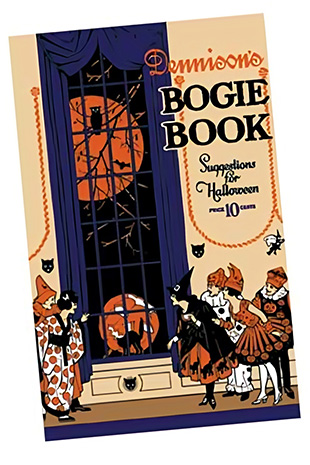
1920s Halloween
Witch Pinup-T

Sweater

Hair Clip
Amazon Halloween links
According to Dr. Protoscience, icy cold, fevers, or even intense grief or fear could “contract the skin at the roots of the hair…prevent the colored oil from rising,” leaving only the dry husk of a strand behind. That’s how someone’s hair could turn white “in a single night”. This trope was not uncommon in old haunted tales.

Advertisements like this 1912 one for a grey hair cure commonly claimed grey hair could be restored to its natural color with a scalp application.
Even creepier, Dr. Protoscience compared grey hair to brittle bones snapping in old age, claiming that an “abundance of lime in the body” could clog the tubes of the hair. In their words, the result was hair that became “grey, dry, and brittle, like the old lady’s bones.” It’s a chilling image. Your hair whitening and withering from the inside out, as if your very skeleton were leeching into it.

You might also like: Rockin’ Rollers Soft Leopard Print Hair Roller
In the spirit of Halloween, it’s easy to see why Victorians might have looked at a sudden streak of grey as something almost supernatural… a visible marker of fright, illness, or mortality itself.
Source: The Toilette of Health, Beauty, and Fashion, 1832

Gasoline Shampoos and Flaming Split Ends
Imagine walking into a beauty salon in the 1930s. But instead of calming aromas and softly humming dryers, the air could reek of gasoline and singed hair. Two treatments I found in my 1939 beauty school book include liquid dry gasoline shampoo and the candle-flame singeing of split ends. They sound more like plot devices from a horror story than steps in a beauty routine.

The Gasoline Shampoo
This method was recommended for women whose health supposedly prevented them from having a “wet” shampoo. A stylist would carefully pour about a cup of gasoline (or a similar solvent like benzine or carbona) over the client’s hair. The instructions were to avoid brushing or manipulating the hair. Just gently lift and soak each section, blot it with a towel, and then fan it dry. Electric or gas dryers were forbidden… for obvious reasons. To finish, an oil or ointment might be rubbed into the hair to soften it again.

You might also like: Vintage Halloween on the Bobby Pin Blog
Gasoline and similar solvents were known as dry-cleaning agents. They dissolve grease and oil effectively, but are highly flammable, toxic to breathe, and harsh on skin. What was once marketed as a clever alternative to water would now be considered a serious health hazard. Modern salons reach for dry shampoos, waterless cleansers, or gentle medicated products instead. The only place a gasoline shampoo belongs is in the history books.
The Singeing of Hair
Also in my Manual on Theory and Practice of Beauty Culture… using a tapered candle to singe split ends. This is in the same book describing gasoline shampooing. Can you see where I’m going here?
Although it seems medieval, singeing hair didn’t disappear after the 1930s. In fact, versions of the practice have reappeared recently under names like velaterapia (a Brazilian “candle cutting” technique that has been trending on and off lately). Celebrities like Alessandra Ambrosio and even a few stylists in Los Angeles and New York promoted it as a luxury split-end treatment. The logic is the same as in 1939: sealing ends with flame to delay fraying.

Caution: Don’t try this at home. The penalty for failure is too great.
According to the manual, a stylist should twist small sections of hair and run the flame of a wax taper quickly along the poking out hair ends to burn away the fraying ends. For short bobs, the taper might be brushed right across the ends of the cut. The manual even notes that singeing should be done before shampooing, so the smell of burnt hair can be washed away.
Putting hair, especially hair often coated in flammable tonics, oils, or even the residue of that gasoline “dry shampoo”, next to an open flame is a disaster waiting to happen. Beauty salons of the 1930s were full of volatile products, heating elements, and little ventilation. The fact that manuals calmly recommended singeing with a taper shows how normalized risk was in beauty routines of the time.

Sweater

Ring Set

Berret

Sweatshirt
Amazon Halloween links
Looking back at these gasoline shampoos, split-end singeing sessions, and radium-laced makeup, it’s hard not to shudder. What was once marketed as cutting-edge science or clever salon technique now feels more like something out of a Halloween horror story.

Of course, every generation has its beauty experiments and some of today’s trends may look just as shocking in a hundred years. Can you think of any that future generations will question us for our sanity?
For now, we can be grateful that our search for glamour no longer involves open flames or radioactivity
 . But these eerie chapters of beauty history remind us that “the price of beauty” has always been more than just a turn of phrase.
Disclosure: Bear in mind that some of the links in this post are affiliate links and if you go through them to make a purchase I may earn a commission.
The post Scary Beauty Trends of the Past… Gasoline Shampoo… Open Flames… Are You People Mad?! appeared first on Vintage Hairstyling.