About 288 minutes
A Source-Book of English Social History — Key Ideas to Explore
Medieval Society
66,103 recorded words. 0 minutes difference from this book's estimate.
View Gutenberg source #54878
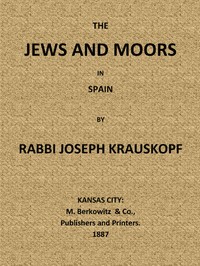
The source record for Jews and Moors in Spain — Reading Notes measures this digital text at 66,227 words, 4 hr 48 min estimated reading time, and 9 detected text sections.
The text analysis averages about 20.4 words per sentence, while the detected sections provide another way to judge how the source is divided.
Project Gutenberg metadata also associates the work with “Jews -- Spain,” connecting these edition facts with the source record’s subject description.
Explore this collection
These alternatives are selected using recorded categories and estimated reading time.
About 288 minutes
Medieval Society
66,103 recorded words. 0 minutes difference from this book's estimate.
View Gutenberg source #54878About 292 minutes
Medieval Society
67,093 recorded words. 4 minutes difference from this book's estimate.
View Gutenberg source #16555About 295 minutes
Medieval Society
67,637 recorded words. 7 minutes difference from this book's estimate.
View Gutenberg source #10494Search stored excerpts and compare books → Choose by your preferences →
Choices use stored catalog measurements. Estimates vary with reading speed. A shared category is a catalog label, not a claim that two books have the same argument or literary quality.
Search reads excerpt text stored with this catalog and links to its associated Gutenberg record. The connection is stored in the site database; this tool does not recheck that every excerpt is word-for-word identical to that external record. Excerpt search does not cover every chapter and does not verify historical publication dates.
Catalog snapshot checked: 2026-09-26. Coverage: 97 public books, 97 available source excerpts.
Calculated from edition completeness, EPUB availability, text structure and catalogue metadata. Not a user rating.
Total of 100 points, scaled to a 2.5-5.0 range. Editions with an empty description or a missing EPUB file are not scored.
Public-domain source text
The source text is kept in the dedicated reader, separate from this catalogue record and its commentary.
Rabbi Joseph Krauskopf's Jews and Moors in Spain (1887) began as a series of Friday-night lectures delivered to his Kansas City congregation, then reprinted by newspapers before being collected into this volume. The work's origin as spoken discourse shapes its prose: sentences are built for the ear, with rhetorical questions, direct address, and periodic summaries that help a listener follow complex historical threads. Krauskopf announces his aim to rescue a neglected epoch from obscurity, and the lectures move through political, religious, and intellectual history with a preacher's sense of moral stakes.
The book's preface reveals its hybrid nature: newspaper reports of oral lectures, revised for publication at the urging of listeners including Missouri's ex-governor. This genesis leaves visible marks. Paragraphs are short, often beginning with a declarative topic sentence. Krauskopf uses repetition for emphasis and occasionally inserts a summarizing phrase as if to catch a wandering mind. The prose is plain, as he claims, but not artless—it carries the cadence of a speaker building toward a point. Readers should note how the text shifts between narrative history and direct moral commentary, a feature of the lecture hall rather than the study.
Krauskopf does not merely describe Jewish intellectual achievement; he quotes it. The excerpts include several poems by Jehuda Ha-Levi, presented in translation with brief commentary. These are not decorative—they serve as primary sources for the claim that Jewish poets matched their contemporaries in skill. The riddle about a needle and the riddle about scissors show a playful, domestic side of Hebrew verse. The longer poem "Night-Thoughts" reveals a personal, almost melancholic voice: "Mine eyes are full of grief—who sees me, asks, / 'Oh wherefore dost thou cling unto the ground?'" Krauskopf uses these texts to argue for the range and depth of Jewish cultural life in Spain, letting the poems speak for themselves.
Because the text was delivered orally, its pacing differs from a conventional history. Krauskopf alternates between broad panorama and close-up example. A lecture might open with a sweeping claim about the "social, political, religious and intellectual life" of Jews and Moors, then narrow to a specific figure or event. The excerpts show this rhythm: a general statement about poetic skill is followed by several translated poems, each with a brief introduction. The effect is cumulative rather than analytical. Readers should expect shifts in tempo—from rapid summary to patient exposition of a single poem—and recognize these as choices of a speaker managing attention in real time.
Krauskopf's lectures reward attention to their form as much as their content. The oral origins explain the directness, the embedded poems, and the moral urgency that surfaces at intervals. Readers may find it useful to imagine the original setting—a synagogue in Kansas City, 1885—and to consider how the author's position as a rabbi shapes his selection of evidence and his tone. The book is not a neutral chronicle but a work of advocacy, written to restore a forgotten chapter to public memory.
Those evenings spent with Rabbi Krauskopf’s lectures left me thinking about how daily toil shapes a civilization’s soul, not just its cathedrals. His poetry of medieval Spain hums with the market’s rhythm, the weaver’s loom. That quiet thought surfaced again when I leafed through An Introduction to the Industrial and Social History of England — Story, Setting & Ideas, and saw the same dance between the mundane and the beautiful.
Capture what you thought, learned, and would like to remember.









