About 248 minutes
The Jacobite Rebellions (1689-1746) (Bell's Scottish History Source Books.) — Background and Themes
Medieval Society
56,953 recorded words. 3 minutes difference from this book's estimate.
View Gutenberg source #23488
The source record for The boke of Saint Albans — Reading Notes measures this digital text at 56,123 words, 4 hr 5 min estimated reading time, and 16 detected text sections.
The text analysis averages about 16.0 words per sentence, while the detected sections provide another way to judge how the source is divided.
Project Gutenberg metadata also associates the work with “Hunting -- Early works to 1800,” connecting these edition facts with the source record’s subject description.
Explore this collection
These alternatives are selected using recorded categories and estimated reading time.
About 248 minutes
Medieval Society
56,953 recorded words. 3 minutes difference from this book's estimate.
View Gutenberg source #23488About 257 minutes
Medieval Society
58,947 recorded words. 12 minutes difference from this book's estimate.
View Gutenberg source #56358About 233 minutes
Medieval Society
53,510 recorded words. 12 minutes difference from this book's estimate.
View Gutenberg source #68963Search stored excerpts and compare books → Choose by your preferences →
Choices use stored catalog measurements. Estimates vary with reading speed. A shared category is a catalog label, not a claim that two books have the same argument or literary quality.
Search reads excerpt text stored with this catalog and links to its associated Gutenberg record. The connection is stored in the site database; this tool does not recheck that every excerpt is word-for-word identical to that external record. Excerpt search does not cover every chapter and does not verify historical publication dates.
Catalog snapshot checked: 2026-09-26. Coverage: 97 public books, 97 available source excerpts.
Calculated from edition completeness, EPUB availability, text structure and catalogue metadata. Not a user rating.
Total of 100 points, scaled to a 2.5-5.0 range. Editions with an empty description or a missing EPUB file are not scored.
Public-domain source text
The source text is kept in the dedicated reader, separate from this catalogue record and its commentary.
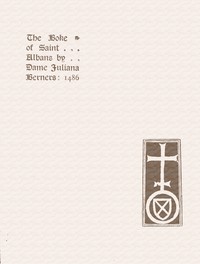
The 1486 printing known as The Boke of Saint Albans survives in so few copies that, as William Blades notes, they “might probably be counted on the fingers of one hand.” This facsimile reproduces the work of the anonymous schoolmaster-printer, preserving a text that blends practical instruction in hawking, hunting, and heraldry with proverbial wisdom and lists of collective nouns. Blades’s introduction, written for the 1881 Elliot Stock edition, examines the book from four angles: authorship, typography, subject-matter, and philology. The result is a volume that offers both a primary source for late medieval English field sports and a case study in early printing history.
Blades organizes his preliminary matter into four chapters, each addressing a distinct aspect of the book. The first chapter weighs the evidence for attributing the treatises to Dame Juliana Berners, noting that historians and biographers have a “natural antipathy to anonymous books” and often accept slender proof. The second chapter turns to the typography of the St Albans press, comparing its type and layout with other incunabula. The third chapter surveys the subject-matter—hawking, hunting, and “cote armour”—while the fourth discusses the language and orthography, which Blades calls “quite different from any other printed work of the fifteenth century.” This systematic approach gives the reader a clear framework for understanding the facsimile that follows.
The text itself is a miscellany of instruction and folk observation. A passage on the properties of a good horse lists fifteen qualities drawn from five creatures: three from a man, three from a woman, three from a fox, three from a hare, and three from an ass. The horse should be “boolde prowde and hardy” like a man, “fayre brestid” like a woman, and have “a faire tayle short eris” like a fox. Elsewhere, the reader finds a set of proverbs warning against building a house of willow, pricking a blind horse over fallows, or letting a wife seek many halows—ending with the wish that God send such a builder “the blysse of euerlastyng galowis.” The book also includes a long list of collective nouns for animals and people, from “a Herde of Hertis” to “a Noonpaciens of wyues.”
Blades emphasizes that the orthography of The Boke of Saint Albans is distinctive, sharing features only with the St Albans Chronicle from the same press. The facsimile allows readers to see the original spelling and abbreviations, such as the use of thorn (þ) and the abbreviation for “with” (wiƚƚ). The text also contains passages of verse and rhyme, like the lines on the ages of a dog: “The .v. yere he is good Inough / The .vi. yere he shaƚƚ holde the plough.” These linguistic details, together with the mix of Latin and English phrases (e.g., “Quia indignacion regis vel principis mors est”), make the book a valuable resource for studying the development of English prose and verse in the late fifteenth century.
Readers approaching this facsimile should be prepared for a text that is part manual, part commonplace book. The treatises on hawking and hunting are practical, but they sit alongside moral sayings and lists that seem designed for memorization. Blades’s introduction provides essential context, but the real interest lies in the juxtaposition of instruction and proverb, of Latin tags and English rhyme. The book rewards slow reading, with attention to the spelling, the rhythm of the prose, and the unexpected turns of phrase that mark it as a product of a particular press and a particular moment in English printing.
That rainy afternoon, the Boke of Saint Albans sat heavy in my lap, its woodcut hawks and precise heraldic beasts strangely soothing against the drumming window. I lingered on the market regulations, those tiny marginal notes about pricing and tolls. Later, almost without thinking, I found myself reaching for a quieter volume, Extracts Relating to Mediaeval Markets and Fairs in England — A Reader’s Guide, its pages filled with the same patient, everyday accounting of lives lived. The two books seemed to whisper to one another across the centuries, sharing a common, unhurried breath.
Create a short personal record of your experience with this book.









