About 967 minutes
England under the Angevin Kings, Volume I — Context and Discussion
Kings Kingdoms
222,365 recorded words. 160 minutes difference from this book's estimate.
View Gutenberg source #68346
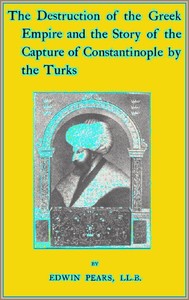
This digital edition of The Destruction of the Greek Empire and the Story of the Capture of Constantinople by the Turks — Context and Discussion is described by source-level measurements including 185,574 words, 13 hr 27 min estimated reading time, and 34 detected text sections.
The text analysis averages about 22.2 words per sentence, while the detected sections provide another way to judge how the source is divided.
Project Gutenberg metadata also associates the work with “Istanbul (Turkey) -- History -- Siege, 1453,” connecting these edition facts with the source record’s subject description.
Explore this collection
These alternatives are selected using recorded categories and estimated reading time.
About 967 minutes
Kings Kingdoms
222,365 recorded words. 160 minutes difference from this book's estimate.
View Gutenberg source #68346About 571 minutes
Kings Kingdoms
131,162 recorded words. 236 minutes difference from this book's estimate.
View Gutenberg source #54953About 526 minutes
Kings Kingdoms
120,920 recorded words. 281 minutes difference from this book's estimate.
View Gutenberg source #20489Search stored excerpts and compare books → Choose by your preferences →
Choices use stored catalog measurements. Estimates vary with reading speed. A shared category is a catalog label, not a claim that two books have the same argument or literary quality.
Search reads excerpt text stored with this catalog and links to its associated Gutenberg record. The connection is stored in the site database; this tool does not recheck that every excerpt is word-for-word identical to that external record. Excerpt search does not cover every chapter and does not verify historical publication dates.
Catalog snapshot checked: 2026-09-26. Coverage: 97 public books, 97 available source excerpts.
Calculated from edition completeness, EPUB availability, text structure and catalogue metadata. Not a user rating.
Total of 100 points, scaled to a 2.5-5.0 range. Editions with an empty description or a missing EPUB file are not scored.
Public-domain source text
The source text is kept in the dedicated reader, separate from this catalogue record and its commentary.
Edwin Pears opens his 1903 history by directly addressing a question: why write another account of Constantinople's fall when Gibbon's version exists? His answer is twofold—new material and Gibbon's bias. The preface lists the limited sources available to Gibbon (Phrantzes, Leonard, Isidore, Ducas, Chalcondylas) and contrasts them with the richer evidence now at hand, including Turkish accounts. This framing signals that the book will not merely retell a familiar story but will re-examine it with a wider evidentiary base.
Pears uses his preface to define the book's purpose and method. He acknowledges Gibbon's brilliance but argues that the historian's bias—and his limited sources—left room for a more accurate account. The preface lists the eyewitnesses Gibbon relied on and notes that no Turkish sources were available to him. Pears then points to the new material he will use, though the excerpt does not specify what those sources are. This opening is not a summary of the siege but a historiographical positioning: the reader is told that this book will be a corrective, not a repetition.
The middle excerpt focuses on a pivotal moment: the Turkish defeat at sea on April 20 and Mahomet II's decision to transport ships overland into the Golden Horn. Pears presents three reasons for the move: weakening the land-wall defence, controlling the Genoese of Galata, and securing supply lines. The analysis is tactical, not dramatic. The author weighs contemporary claims that the sea defeat caused the decision, but he doubts it, suggesting instead that it hastened a pre-existing plan. This careful, evidence-based reasoning is characteristic of the book's approach.
Pears devotes significant attention to the Genoese colony of Galata, describing its walls, its tower, and its precarious neutrality. The excerpt notes that both sides accused the Genoese of aiding the enemy, and that the archbishop (himself a Genoese) complained of his countrymen's mercantile pragmatism. Pears highlights the strategic importance of Galata: its possession of the northern shore of the Golden Horn made it a potential threat to Mahomet. The author's treatment of the Genoese is nuanced, acknowledging their sympathy for fellow Christians while also recognizing their commercial ties to the Turks.
The provided excerpts cover only the preface and a portion of the siege narrative. They do not include the book's earlier chapters on the Latin conquest or the rise of the Turks, nor do they reveal the outcome of the siege or the fate of the city. The reader should not assume that the book is solely a military history; the preface promises a broader summary of the empire between 1204 and 1453. The excerpts show a work that is analytical, source-critical, and focused on decision-making, but they offer no evidence of Pears's treatment of the final assault or the aftermath.
As you read, note how Pears balances narrative momentum with historiographical commentary. The preface warns that this is not a simple retelling; the middle sections demonstrate that claim. Pay attention to how the author handles sources—when he doubts a contemporary account, and when he accepts it. The book's value lies not just in the story it tells, but in the evidence it weighs.
Sometimes I think of Pears’s Constantinople, those ships hauled over the hills, and how empires hinge on such stubborn invention. It reminds me of another shore, where Norse and Irish left their marks on each other’s stories, quieter but just as real. Scandinavian Relations with Ireland During the Viking Period — Themes and Context holds that same ache of histories we only half know, their footprints fading into the grass.
A brief reflection can help important ideas stay with you longer.