About 708 minutes
History of the Anglo-Saxons, from the Earliest Period to the Norman Conquest Second Edition — A Reader’s Guide
Medieval Society
162,795 recorded words. 24 minutes difference from this book's estimate.
View Gutenberg source #45366
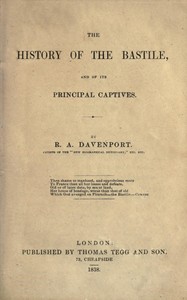
The history of the Bastile, and of its principal captives — Edition Insights can be approached with a clearer sense of reading commitment from its source measurements: 157,171 words, 11 hr 24 min estimated reading time, and 21 detected text sections.
The text analysis averages about 25.1 words per sentence, while the detected sections provide another way to judge how the source is divided.
Project Gutenberg metadata also associates the work with “Bastille -- History,” connecting these edition facts with the source record’s subject description.
Explore this collection
These alternatives are selected using recorded categories and estimated reading time.
About 708 minutes
Medieval Society
162,795 recorded words. 24 minutes difference from this book's estimate.
View Gutenberg source #45366About 715 minutes
Medieval Society
164,350 recorded words. 31 minutes difference from this book's estimate.
View Gutenberg source #10103About 622 minutes
Medieval Society
142,998 recorded words. 62 minutes difference from this book's estimate.
View Gutenberg source #11953Search stored excerpts and compare books → Choose by your preferences →
Choices use stored catalog measurements. Estimates vary with reading speed. A shared category is a catalog label, not a claim that two books have the same argument or literary quality.
Search reads excerpt text stored with this catalog and links to its associated Gutenberg record. The connection is stored in the site database; this tool does not recheck that every excerpt is word-for-word identical to that external record. Excerpt search does not cover every chapter and does not verify historical publication dates.
Catalog snapshot checked: 2026-09-26. Coverage: 97 public books, 97 available source excerpts.
Calculated from edition completeness, EPUB availability, text structure and catalogue metadata. Not a user rating.
Total of 100 points, scaled to a 2.5-5.0 range. Editions with an empty description or a missing EPUB file are not scored.
Public-domain source text
The source text is kept in the dedicated reader, separate from this catalogue record and its commentary.
Davenport opens his 1838 history with a frank admission: his original plan to link the Bastille's story with that of France proved too ambitious for a single volume. He had hoped to trace the parties and factions that supplied state prisons, but space forced him to narrow his scope. The result, he claims, is the only English work with any pretension to be called a history of the Bastille. Readers should note the consistent spelling 'Bastile' throughout, as the transcriber points out. The book begins with a detailed description of the fortress itself—its towers, dungeons, apartments, and even the prisoners' garden and library—before moving to the system of lettres de cachet and the narratives of individual captives.
In his Advertisement, Davenport compares his finished work to an oriental fruit-hawker's cry: 'In the name of the Prophet—figs!' He began loftily but ended, he fears, with something far less grand. This self-deprecating metaphor sets a tone of scholarly honesty. He acknowledges that the publisher enlarged the page and added pages at considerable cost to reduce the work's imperfections, yet he still felt 'exceedingly cramped by the want of adequate space.' Despite these constraints, Davenport insists he consulted every accessible document and tried to be 'strictly just, and to combine information with amusement.' His hope is that the volume will keep alive an abhorrence of arbitrary power and inspire affection for governments that promote the people's happiness. This opening frames the book as a conscientious, if imperfect, compilation.
The table of contents reveals a systematic approach: the first chapter covers the original meaning of 'Bastile,' descriptions of various bastiles, then a detailed look at 'The Bastile' itself—its officers, interior, garden, exercise court, towers, dungeons, apartments, furniture, and food. Also included are the library, chapel, and an explanation of lettres de cachet. This granular inventory suggests Davenport wanted readers to understand the fortress not just as a symbol but as a functioning prison. The chapter headings promise a shift from physical description to the system of arbitrary imprisonment, then to narratives of principal captives. The book's structure thus moves from place to institution to individual stories, giving readers a layered understanding of how the Bastille operated.
One of the most detailed excerpts concerns Nicolas Fouquet, Louis XIV's superintendent of finances. Davenport recounts how Mazarin, on his deathbed, awakened Louis's suspicions against Fouquet, leaving behind two deadly foes: Le Tellier and Colbert. The king, determined to be his own prime minister, secretly examined financial statements with Colbert's help, unravelling Fouquet's 'artful tangles.' Louis believed Fouquet aspired to sovereignty—a fear Davenport calls 'absurd,' noting the only evidence was Fouquet's purchase and fortification of Belleisle for commercial purposes. A further motive, Davenport suggests, was Fouquet's imprudent attempt to include La Vallière among his mistresses. The king and Colbert used 'profound dissimulation,' even hinting at the premiership, to lull Fouquet while stripping him of his legal privilege of trial by the assembled chambers. This episode illustrates Davenport's method: he presents multiple causes—financial, political, and personal—without reducing the story to a single motive.
Davenport's work is a product of its time, and readers should attend to his rhetorical choices. He quotes Madame de Motteville's remark that few at court 'did not sacrifice to the golden calf,' and a sarcastic writer's note that nobles invited to Vaux 'did not forget to take away' the gold left in their rooms. These asides reveal Davenport's moral stance: he condemns the corruption of the court while acknowledging that policy, lust, and vanity all played a part. He also distinguishes between the nobles who deserted Fouquet in danger and the 'people of talent' who clung to him. This binary—corrupt nobility versus loyal men of talent—reflects early nineteenth-century liberal values. Readers should consider how Davenport's own context shapes his portrayal of absolutism and arbitrary power.
Davenport's history is best approached as a purposeful compilation rather than a seamless narrative. The excerpts show him weaving together physical description, institutional analysis, and dramatic biography, all while acknowledging the work's limitations. Readers may find it useful to track how he balances his stated goals—to inform and to inspire abhorrence of tyranny—with the constraints of his sources and space. The book rewards attention to its structure and to the author's candid asides about his own process.
Reading about the Bastille’s cold stone and its quiet, forgotten officers, I found myself thinking of how daily habits outlast walls. There’s a gentle ache in tracing those names no history book remembers fully. That same feeling—of lives tucked into routine—lingers in The Customs of Old England — Edition Insights, like a familiar scent from a doorway you once passed. It stayed with me, softly.
Create a short personal record of your experience with this book.









