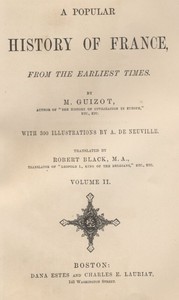
The volume opens not with a battle but with a legal document: the Assizes of Jerusalem, drawn up by Godfrey de Bouillon in 1099. Guizot immediately signals that his interest lies in institutions and governance, not merely military exploits. The Crusades, he argues, were already showing signs of decline even as Jerusalem fell, and he traces this through the failure to sustain Christian rule in the East. This focus on administrative and constitutional history—rather than dramatic narrative—characterizes the entire work.
Readers should expect a methodical, evidence-driven account. Guizot frequently cites charters, royal ordinances, and municipal customs, such as the charter of Lorris (1155) and the privileges granted to Orleans. These documents are not footnotes but central to his argument about the evolution of French society.
The Crusades as Institutional History
Guizot treats the Crusades not as a religious epic but as a political and social phenomenon. He notes that after the initial conquest, the crusaders “calculated so surely upon their future” that they codified laws—the Assizes of Jerusalem—as if their rule were permanent. Yet within a generation, the Latin kingdoms were crumbling. Guizot’s evidence is concrete: the failure to hold Antioch and Edessa, the rise of Saladin, and the internal divisions among crusader leaders. He does not moralize; he observes that the crusading movement declined because it lacked sustainable institutions.
The excerpts show Guizot’s method: he moves from a specific document (the Assizes) to broader trends, then back to local examples. For instance, he contrasts the high hopes of 1099 with the reality of 1187, when Jerusalem fell. This pattern—document, analysis, comparison—recurs throughout the volume.
Royal Power and Urban Privileges
Guizot devotes considerable attention to how French kings strengthened their authority by granting charters to towns. He cites Philip Augustus exempting Orleans from talliage in 1183, and Louis the Young confirming the charter of Lorris in 1155. These grants were not acts of generosity but calculated moves to bind towns to the crown. Guizot writes that the king “promoted in his administration the progress of civilization and the counsels of reason,” attaching burghers to the monarchy without granting them full political independence.
The charter of Lorris is presented as a model: it regulated financial, commercial, judicial, and military matters, and was so popular that other towns requested “the customs of Lorris.” Guizot emphasizes that these towns did not become true communes—they lacked independent magistracies—but they gained security and prosperity. This nuanced distinction between royal favor and communal autonomy is central to his argument.
Bishops and Communal Revolts
Not all urban progress came from kings. Guizot highlights the role of bishops, some of whom “listened to the counsels of reason.” He introduces Baudri de Sarchainville, elected Bishop of Noyon in 1098, who saw the commune as “a sort of necessity” and chose to negotiate rather than shed blood. This example illustrates Guizot’s interest in individual actors who shaped institutional change.
The excerpts also mention troubles in Cambrai between bishops and people, and an insurrection in favor of the commune at Cambrai. Guizot uses these episodes to show that communal movements were not uniform; they involved negotiation, conflict, and varying outcomes. He avoids romanticizing the communes, instead presenting them as part of a complex power struggle among kings, bishops, and burghers.
The Hundred Years’ War Begins
The later chapters shift to the Hundred Years’ War, but Guizot’s approach remains institutional. He examines the States-General of the fourteenth century, the role of Étienne Marcel, and the reign of Charles V. The excerpts include references to “the hanging of Marigny” and “the murder of the marshals,” indicating that Guizot does not shy from violence, but he frames it within constitutional crises.
He also introduces figures like Bertrand Du Guesclin, but the focus is on how the war reshaped royal authority and taxation. The illustrations listed—such as “Queen Philippa at the Feet of the King” and “Putting the Keys on Du Guesclin’s Bier”—suggest that Guizot uses visual evidence to complement his text. Readers should note that the excerpts are incomplete; the full chapters likely provide more detailed military and diplomatic analysis.
Guizot’s history is best read as a series of interconnected case studies in state formation. The excerpts reveal a writer who prizes documents—charters, laws, chronicles—and uses them to build arguments about power, liberty, and social change. Readers will benefit from paying attention to the specific texts he cites, as they are the foundation of his analysis. The volume does not offer a simple narrative; it demands engagement with evidence and invites comparison between different periods and regions.
I finished Guizot’s second volume the other evening, lingering over those commune charters—how ordinary townspeople slowly carved out a little room to breathe. It made me think of another quiet moment in history, a hinge of fate. The memory of that afternoon at Poitiers — Key Ideas to Explore felt like a soft echo of the same, stubborn human insistence on order.