About 112 minutes
Poitiers — Key Ideas to Explore
Crusades
25,558 recorded words. 6 minutes difference from this book's estimate.
View Gutenberg source #32197
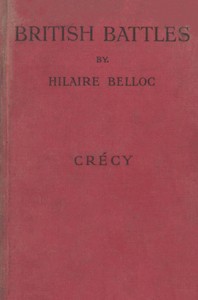
Crécy — Text and Context can be approached with a clearer sense of reading commitment from its source measurements: 24,368 words, 1 hr 46 min estimated reading time, and 7 detected text sections.
The text analysis averages about 27.7 words per sentence, while the detected sections provide another way to judge how the source is divided.
Project Gutenberg metadata also associates the work with “Crécy, Battle of, Crécy-en-Ponthieu, France, 1346,” connecting these edition facts with the source record’s subject description.
Explore this collection
These alternatives are selected using recorded categories and estimated reading time.
About 112 minutes
Crusades
25,558 recorded words. 6 minutes difference from this book's estimate.
View Gutenberg source #32197About 169 minutes
Crusades
38,825 recorded words. 63 minutes difference from this book's estimate.
View Gutenberg source #65142About 189 minutes
Crusades
43,243 recorded words. 83 minutes difference from this book's estimate.
View Gutenberg source #40630Search stored excerpts and compare books → Choose by your preferences →
Choices use stored catalog measurements. Estimates vary with reading speed. A shared category is a catalog label, not a claim that two books have the same argument or literary quality.
Search reads excerpt text stored with this catalog and links to its associated Gutenberg record. The connection is stored in the site database; this tool does not recheck that every excerpt is word-for-word identical to that external record. Excerpt search does not cover every chapter and does not verify historical publication dates.
Catalog snapshot checked: 2026-09-26. Coverage: 97 public books, 97 available source excerpts.
Calculated from edition completeness, EPUB availability, text structure and catalogue metadata. Not a user rating.
Total of 100 points, scaled to a 2.5-5.0 range. Editions with an empty description or a missing EPUB file are not scored.
Public-domain source text
The source text is kept in the dedicated reader, separate from this catalogue record and its commentary.
Belloc opens Crécy by drawing a sharp distinction between ancient and modern military history, asserting that for the 1,400 years preceding the sixteenth century, contemporary records never give full details of an action. He states that to describe a medieval battle with accuracy, one must 'reconstitute' it by arguing from known conditions to unknown. This methodological claim frames the entire work: the reader is not offered a simple narrative but a forensic reconstruction based on texts, traditions, and topography.
The introduction immediately warns that numbers, hours, weather, and even the fact of a battle are often uncertain, and that dramatic successes like Crécy naturally lead to exaggerated disproportion. Belloc thus positions his study as a corrective to legend, grounded in evidence rather than romance.
Belloc insists that medieval battles differ entirely from modern ones in their evidence. Manuscript authorities are 'often rare, sometimes unique,' never provide maps, and rarely give definite topographical indications. Their motives are 'ecclesiastical or civil rather than military,' and they preserve at best 'the picturesque side of an engagement.' This candid assessment prepares the reader for the detective work that follows. Belloc does not pretend to certainty; he repeatedly qualifies his conclusions with phrases like 'we can be certain, however, that so far as tradition goes' and 'we must expect, therefore.' The reader is invited to follow the reasoning, not merely accept the result.
A central puzzle is the exact site of the Blanchetaque ford across the Somme. Belloc assembles multiple lines of evidence: local traditions gathered as late as 1840, the alignment of Roman roads, parish boundaries, and the location of mills and tombs. He notes that the ford's northern end was said to be 'from 1200 to 1500 metres below Port,' but that Port itself is 500 yards long, leaving a margin of error. He then uses the necessity of crossing the Authie River at the Roman bridge of Ad Pontes (Ponches) to narrow the possible route. This kind of layered argument—combining textual, traditional, and geographical clues—is typical of Belloc's method throughout the book.
Belloc devotes an entire section to the terrain of Crécy, treating the landscape as an active element in the battle. He describes the tidal estuary, the reclamation of land that destroyed old contours, and the modern bridges and railways that have obscured the medieval geography. His sketch map (indicated on p. 60) attempts to reconstruct the river channel before reclamation. The reader is shown how physical geography—the course of the Somme, the marshes of the Authie, the ridge lines—shaped the campaign. Belloc's prose is precise and concrete, avoiding romanticism: he writes of 'levelled, heightened, and now fruitful pastures' rather than picturesque vistas.
Throughout the excerpts, Belloc relies on tradition as a valid form of evidence, but he handles it critically. He notes that the peasants' indications of the traditional ford site were 'unfortunately not marked on a map,' and that the margin of error is more than double the expected 300 yards. He also uses negative evidence: the disappearance of the ford's cause for repair after modern bridges made it obsolete. This careful weighing of probabilities—'we can regard as completely established' only after converging lines of proof—gives the book its distinctive tone. The reader is not told what happened so much as shown how we can know it.
Belloc's Crécy rewards a reader who attends to method as much as to narrative. The book is less a battle account than a demonstration of how to recover a medieval engagement from scattered clues. Pay particular attention to the maps and the reasoning about topography; Belloc often builds his case on the shape of a riverbank or the line of a Roman road. The excerpts suggest that the later sections on the action itself will depend on the groundwork laid in the terrain analysis. Read with a willingness to follow chains of inference, and the battle emerges not as a single event but as a puzzle solved piece by piece.
When I finished Belloc’s careful reconstruction of the Crécy fight, with all its patient sifting of ford and field, I found myself thinking of my old copy of Secret Societies of the Middle Ages — Reading Notes, almost fondly. Both felt like assembling a mosaic from scattered shards—each detail a quiet whisper from a past that refuses to be whole. There is a comfort in that fragmentary honesty, I suppose.
Build a private reading journal entry for this title.