About 299 minutes
Richard II Makers of History — Background and Themes
Kings Kingdoms
68,743 recorded words. 10 minutes difference from this book's estimate.
View Gutenberg source #28433
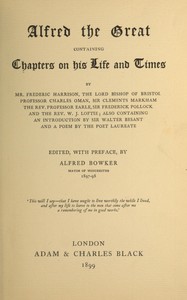
Before opening Alfred the Great — A Closer Reading, the edition data offers a quick orientation: 66,358 words, 4 hr 49 min estimated reading time, and 25 detected text sections.
The text analysis averages about 24.7 words per sentence, while the detected sections provide another way to judge how the source is divided.
Project Gutenberg metadata also associates the work with “Alfred, King of England, 849-899,” connecting these edition facts with the source record’s subject description.
Explore this collection
These alternatives are selected using recorded categories and estimated reading time.
About 299 minutes
Kings Kingdoms
68,743 recorded words. 10 minutes difference from this book's estimate.
View Gutenberg source #28433About 268 minutes
Kings Kingdoms
61,605 recorded words. 21 minutes difference from this book's estimate.
View Gutenberg source #25275About 345 minutes
Kings Kingdoms
79,322 recorded words. 56 minutes difference from this book's estimate.
View Gutenberg source #40513Search stored excerpts and compare books → Choose by your preferences →
Choices use stored catalog measurements. Estimates vary with reading speed. A shared category is a catalog label, not a claim that two books have the same argument or literary quality.
Search reads excerpt text stored with this catalog and links to its associated Gutenberg record. The connection is stored in the site database; this tool does not recheck that every excerpt is word-for-word identical to that external record. Excerpt search does not cover every chapter and does not verify historical publication dates.
Catalog snapshot checked: 2026-09-26. Coverage: 97 public books, 97 available source excerpts.
Calculated from edition completeness, EPUB availability, text structure and catalogue metadata. Not a user rating.
Total of 100 points, scaled to a 2.5-5.0 range. Editions with an empty description or a missing EPUB file are not scored.
Public-domain source text
The source text is kept in the dedicated reader, separate from this catalogue record and its commentary.
This volume, published in 1899 as part of the millenary commemoration of King Alfred's death, brings together essays by several leading historians of the day. The editor, Alfred Bowker, explains that the book aims to diffuse public knowledge of the king's life and work, and is deliberately kept inexpensive and concise. The opening poem by Alfred Austin, the Poet Laureate, sets a reverent tone, calling Alfred the 'spotless king' and linking his fame to the places of his life: 'Lone Athelney, victorious Ethandune, Wantage his cradle, Winchester his grave.'
The book is structured as a series of chapters by different authors, each focusing on a distinct aspect of Alfred's reign. Contributors include Frederic Harrison, the Bishop of Bristol, Professor Charles Oman, Sir Clements Markham, and others. This format allows for specialized treatment of topics such as military organization, law, and learning, but also means the narrative is not a single, continuous biography. The preface acknowledges that numerous subjects and possible illustrations have been left for a full biography, so the reader should expect a selective, thematic approach rather than a comprehensive life story.
The excerpt on Alfred's military reforms describes how he increased the number of thegns by promoting ceorls and merchants who could afford full armor, binding them to follow the king 'to the field in full mail.' This created a more efficient core for the national host. The campaigns of 893–896 are presented as the best test of this reorganisation. The narrative details Alfred's strategy of shadowing the Danish forces, using 'wood-fastnesses and water-fastnesses' to block their movements, and his decisive actions at Farnham, Benfleet, and the Lea. The account emphasizes Alfred's personal mobility—he flew westward to deal with a siege at Exeter while his army stormed Benfleet—and his relentless pursuit that eventually broke the 'Great Army.'
The volume's framing emphasizes Alfred's moral and intellectual qualities. The dedicatory poem insists that 'none are truly great that are not good,' and the preface speaks of the king's 'claim on the gratitude and love of the English-speaking race.' The excerpt on the campaigns concludes with a note of thanks that 'the army had not broken up the English race,' linking military success to national survival. The book thus presents Alfred not only as a military leader but as a model of wisdom and virtue, a pattern for rulers. The reader should note that this hagiographic tone is part of the commemorative purpose, and the essays may reflect late-Victorian ideals of kingship and national identity.
Readers approaching this collection should be aware that it is a product of its time—a Victorian tribute designed for a broad audience. The essays vary in depth and style, and the book assumes some familiarity with early English history. For those interested in the details of Alfred's military campaigns or his administrative reforms, the chapters by Oman and Pollock are particularly valuable. The volume also offers a glimpse into how Alfred was remembered and celebrated at the turn of the twentieth century, making it a document of historical reception as well as a source of information about the king himself.
Years spent with Alfred the Great taught me how a king’s quiet wisdom can outlast sieges and stones, a patience woven into every page. That same steady hand feels present when I linger over England under the Angevin Kings, Volume I — Context and Discussion, whose dusty shelves near mine hold a gentler, stranger kind of rule. Both whisper of endurance, old friends trading secrets.
A brief reflection can help important ideas stay with you longer.