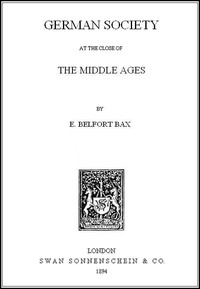
German Society at the Close of the Middle Ages — Context and Discussion

(0 User reviews)   330
In Category - Middle Ages
Bax, Ernest Belfort, 1854-1926 Project Gutenberg 2015 Not confirmed
Germany -- Social conditions; Reformation -- Germany Readers of public-domain and historical texts
Project Gutenberg digital edition en

Edition facts

Words 59,653
Reading time 260 min
Text sections 6

Before opening German Society at the Close of the Middle Ages — Context and Discussion, the edition data offers a quick orientation: 59,653 words, 4 hr 20 min estimated reading time, and 6 detected text sections.

The text analysis averages about 28.3 words per sentence, while the detected sections provide another way to judge how the source is divided.

Project Gutenberg metadata also associates the work with “Germany -- Social conditions,” connecting these edition facts with the source record’s subject description.

Explore this collection

Compare your next read

These alternatives are selected using recorded categories and estimated reading time.

Search stored excerpts and compare books → Choose by your preferences →

How these choices and excerpts are prepared

Choices use stored catalog measurements. Estimates vary with reading speed. A shared category is a catalog label, not a claim that two books have the same argument or literary quality.

Search reads excerpt text stored with this catalog and links to its associated Gutenberg record. The connection is stored in the site database; this tool does not recheck that every excerpt is word-for-word identical to that external record. Excerpt search does not cover every chapter and does not verify historical publication dates.

Catalog snapshot checked: 2026-09-26. Coverage: 97 public books, 97 available source excerpts.

Examines social conditions and popular movements in Germany from the late 15th century to 1525, focusing on economic, juridical, and folkloric tensions rather than theology or politics.
Share
Editorial Edition Score 4.7/5

Calculated from edition completeness, EPUB availability, text structure and catalogue metadata. Not a user rating.

How this score is calculated
  • Description quality20 pts
  • Title & short description10 pts
  • Source metadata20 pts
  • Text length15 pts
  • Chapters / structure15 pts
  • EPUB file integrity20 pts

Total of 100 points, scaled to a 2.5-5.0 range. Editions with an empty description or a missing EPUB file are not scored.

Edition quality

Public-domain source text

Read the source text

The source text is kept in the dedicated reader, separate from this catalogue record and its commentary.

Ernest Belfort Bax's study deliberately sets aside the theological disputes that dominate Reformation histories, aiming instead to reconstruct the social and economic ground beneath the upheavals. The volume, the first of a planned trilogy, covers the period from the closing years of the fifteenth century through the Peasants' War of 1525. Bax draws on sources such as Luther's table talk and legal records to trace the disintegration of medieval structures. The preface signals a materialist approach: underlying causes—economic, social, juridical—are the real drivers of the narrative, not the doctrinal quarrels that occupied contemporary pamphleteers.

Folklore as Social Symptom

The chapter on folklore does not treat folk tales as quaint survivals but as evidence of a society in crisis. Bax recounts Luther's stories of changelings, devilish compacts, and witchcraft with a clinical eye. In one anecdote, a peasant drowns his own child after a voice from a brook confirms it is a changeling; Luther reportedly advised drowning such creatures, calling them 'lumps of flesh animated by the devil.' These narratives reveal a theological hardening: the old pagan spirits are recast as agents of Satan, a shift Bax links to the coming witchcraft panics. The folklore section thus functions as a diagnostic tool, showing how popular belief was reshaped by Reformation anxieties about evil and salvation.

The New Jurisprudence and Social Control

Bax devotes a chapter to the transformation of law in the period. He argues that the reception of Roman law undermined customary rights, especially for peasants, and concentrated power in territorial princes. The new jurisprudence is presented as a weapon of social discipline, replacing local arbitration with codified procedures that favored the propertied. Bax notes that legal pedantry—insistence on witnesses and evidence—was itself suspect to reformers like Luther, who believed the devil could harden suspects against torture. The chapter connects legal change directly to the grievances that exploded in 1525, grounding the Reformation's social conflicts in concrete shifts of authority.

Town and Country at the End of the Middle Ages

The relationship between urban and rural life is a recurring thread. Bax contrasts the growing autonomy of German towns with the tightening seigneurial control over the countryside. The town offered guild organization and civic rights, but also new forms of inequality; the countryside saw the erosion of common lands and the intensification of labor dues. Bax does not idealize either sphere. He notes that the Revolt of the Knighthood (1522–23) and the Peasants' War were separate but overlapping rebellions, each rooted in distinct economic pressures. The urban–rural divide, he suggests, was both a source of tension and a structural feature that shaped the failure of unified revolt.

Readers approaching this work should expect a materialist analysis that privileges economic and legal structures over personalities or doctrine. Bax's use of folklore and legal history as primary evidence gives the book an unusual texture. The volume is best read as a companion to more conventional Reformation histories, filling in the social substratum that doctrinal accounts often ignore. Those interested in the Peasants' War or the early Reformation's popular dimensions will find a detailed, if partisan, framework for understanding the period's convulsions.

Reading about the quiet unrest in late medieval German villages—the grinding economic tensions beneath the folk customs—I found myself remembering another afternoon, another book. The same shadow seemed to fall across both: the fear that shaped ordinary lives. That older, broader examination of how belief systems policed daily existence came back to me, patiently. A History of the Inquisition of the Middle Ages; volume I — Story, Setting & Ideas felt like a distant, slower echo of the same human ache. I simply sat with that thought for a while.

There are no reviews for this eBook.

0
0 out of 5 (0 User reviews )

Add a Review

Your Rating *
There are no comments for this eBook.

Reader reflection

Before you leave, reflect on the book

Use these questions to collect your thoughts before moving on.

Your progress 0 / 10
1

Which reading stage best describes you?

2

How did the book work for you overall?

3

Would you recommend this book to another reader?

4

How demanding did the text feel?

Related eBooks