About 1,293 minutes
The Life of Joan of Arc, Vol. 1 and 2 — Context and Discussion
Medieval Society
297,359 recorded words. 27 minutes difference from this book's estimate.
View Gutenberg source #19488
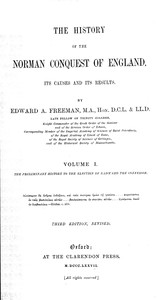
The history of the Norman conquest of England, its causes and its results, Volume 1 (of 6) — Inside the Classic can be approached with a clearer sense of reading commitment from its source measurements: 303,448 words, 22 hr estimated reading time, and 52 detected text sections.
The text analysis averages about 20.3 words per sentence, while the detected sections provide another way to judge how the source is divided.
Project Gutenberg metadata also associates the work with “Normans -- England,” connecting these edition facts with the source record’s subject description.
Explore this collection
These alternatives are selected using recorded categories and estimated reading time.
About 1,293 minutes
Medieval Society
297,359 recorded words. 27 minutes difference from this book's estimate.
View Gutenberg source #19488About 1,157 minutes
Medieval Society
265,952 recorded words. 163 minutes difference from this book's estimate.
View Gutenberg source #14754About 822 minutes
Medieval Society
188,960 recorded words. 498 minutes difference from this book's estimate.
View Gutenberg source #58614Search stored excerpts and compare books → Choose by your preferences →
Choices use stored catalog measurements. Estimates vary with reading speed. A shared category is a catalog label, not a claim that two books have the same argument or literary quality.
Search reads excerpt text stored with this catalog and links to its associated Gutenberg record. The connection is stored in the site database; this tool does not recheck that every excerpt is word-for-word identical to that external record. Excerpt search does not cover every chapter and does not verify historical publication dates.
Catalog snapshot checked: 2026-09-26. Coverage: 97 public books, 97 available source excerpts.
Calculated from edition completeness, EPUB availability, text structure and catalogue metadata. Not a user rating.
Total of 100 points, scaled to a 2.5-5.0 range. Editions with an empty description or a missing EPUB file are not scored.
Public-domain source text
The source text is kept in the dedicated reader, separate from this catalogue record and its commentary.
Freeman opens this volume not with the Norman Conquest itself but with a lengthy preliminary history reaching back to the earliest English settlements. The narrative voice is distinctive: it combines the authority of a Victorian don with a storyteller's eye for dramatic moments. In the excerpt describing Duncan's siege of Durham, for instance, Freeman shifts from careful chronology to a vivid tableau of Scottish heads displayed on the battlements, a detail he calls a 'garland' and a 'bloody trophy.' This oscillation between dry annals and visceral imagery is a hallmark of his method.
The author also frequently interrupts his own narrative to comment on sources, correct earlier historians, or note the first appearance of a place name in the chronicles. These asides give the work a layered, almost conversational texture, as if the reader is being guided through a library of conflicting records.
Freeman's prose does not maintain a single register. In the passage on Harthacnut's preparations, he writes in a clipped, factual style: 'Harthacnut therefore was now able to turn his thoughts in the direction of England.' But when describing the aftermath of battle, he lets loose a more florid vocabulary: 'Northumbrian barbarism showed itself now as on the former occasion.' The effect is that of a lecturer who can, at will, zoom in from a wide-angle view of treaties and successions to a close-up of gore and glory.
This variability is not accidental. Freeman often uses a sudden intensification of language to mark what he considers a moral or national turning point. The reader learns to watch for these shifts: a plain sentence about a king's death may be followed by a paragraph of elevated reflection on the meaning of the event. The result is a history that feels both meticulous and impassioned.
Freeman slows the narrative considerably when he reaches a place or person that interests him. The siege of Durham, for example, prompts a mini-essay on the city's growth under Bishop Eadmund, complete with a miraculous voice story. This digression is not strictly necessary for the political narrative, but it gives the reader a sense of lived geography. Similarly, the mention of Westminster as 'now mentioned in our Chronicles for the first time' leads to a brief speculation about the earlier monastery's reputation.
These pauses create a rhythm: the main thread of kings and battles advances in bursts, then halts for a local color or a textual note. The effect is cumulative; by the time the reader reaches the election of Edward the Confessor, the landscape of England feels thick with remembered events and contested interpretations.
The preface to the third edition reveals that Freeman revised his own work with an eye to 'mere style,' replacing 'stranger' words with 'good English' ones. This self-awareness extends into the body of the text, where he frequently corrects or qualifies earlier historians. In the excerpt, he notes that the murder of Sigeferth and Morkere has been 'confounded' with the massacre of Saint Brice, and that he has altered his narrative accordingly.
These interventions give the reader a sense of watching history being constructed in real time. Freeman does not pretend to offer a finished, seamless account; he points to his own sources, acknowledges uncertainty, and sometimes leaves a question open. This honesty about the limits of evidence is one of the book's most enduring qualities, even as its Victorian assumptions about race and progress date it.
Readers approaching this first volume should expect a work that is as much about the writing of history as about the events themselves. Freeman's habit of pausing to weigh evidence or to savour a dramatic scene means that the narrative moves at an uneven pace. Patience with his digressions is rewarded by a richer understanding of how the Norman Conquest was prepared for, not just by kings and armies, but by the chroniclers and places that preserved their memory.
Freeman’s way of pausing over a single charter made me feel the weight of each held stone, and I found myself drifting to The history of the Bastile, and of its principal captives — Edition Insights, where walls remember so many quiet footsteps. Both books treat stone as a witness, never hurrying past a name scratched into darkness. That patience lingers with me.
A brief reflection can help important ideas stay with you longer.









